
Criminal Cases in the Claiborne County Courts
Claiborne County is part of Tennessee's Eighth Judicial District. The Circuit Court Clerk maintains the Criminal Court side for felony files and other court-of-record work. Its listed holdings include indictments, felony and misdemeanor motions, appeals, post-conviction matters, trial exhibits, probation violations, search warrants, and Grand Jury reports. General Sessions handles criminal warrants, citations, capias matters, pleas, petitions, misdemeanor matters within its jurisdiction, and preliminary felony work. City courts in Harrogate, New Tazewell, and Tazewell keep ordinance cases on a separate track.
The local criminal counter is at 415 Straight Creek Road, Suite 5, New Tazewell, TN 37825. Call 423-626-3334 or email circuitcourtclerk@claibornecountytn.gov. The civil and Chancery office at 1740 Main Street is not the main criminal-file counter. That local split is worth checking before a trip.
General Sessions and the criminal clerk share the Straight Creek complex, but their work is not identical. Ask staff whether the requested Claiborne County record is a warrant file, a preliminary matter, or a Criminal Court prosecution. The General Sessions and Juvenile judge's office is listed in Suite 6, with directory numbers 423-626-6113 and 423-626-5208. Calling first also lets a visitor confirm the right counter, current security rules, and any access needs that official pages do not spell out.
The official Claiborne County court page shows the clerk's criminal jurisdiction and contact details.
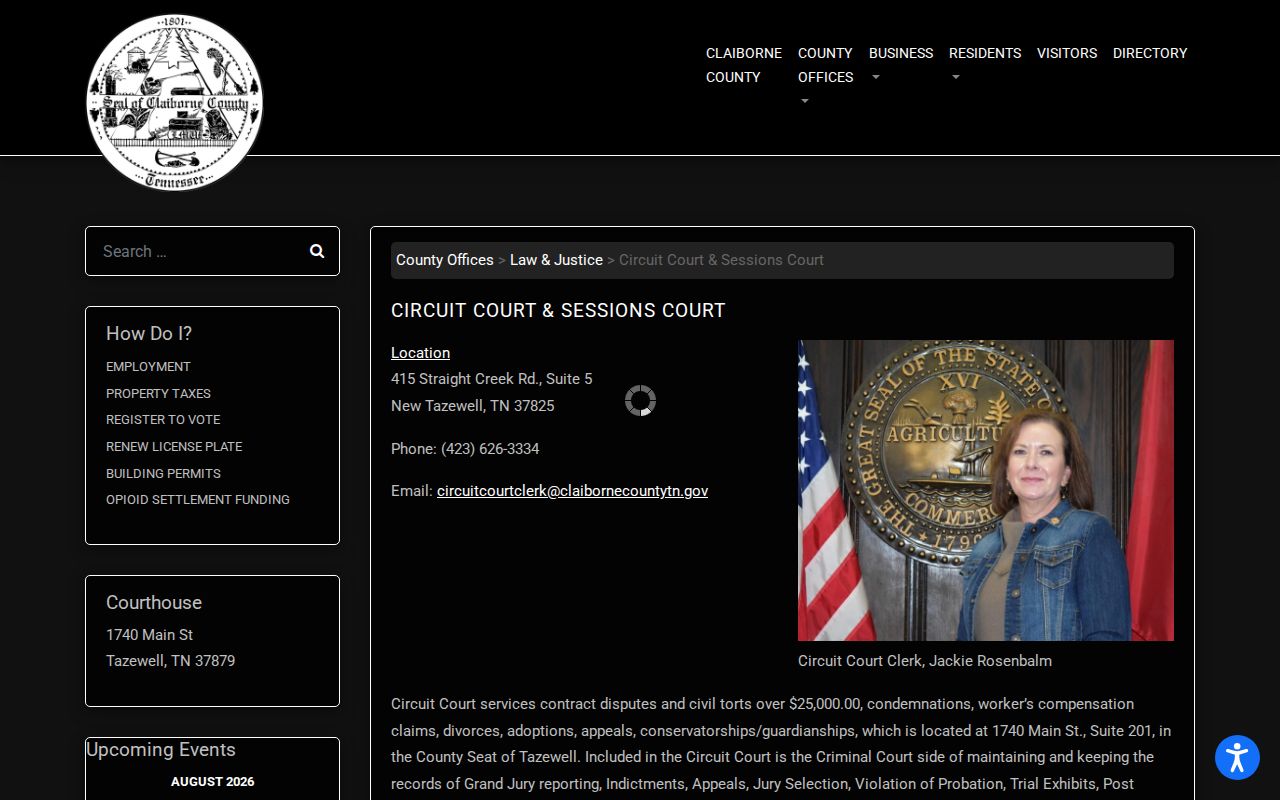
The image reinforces why court type and office location should be confirmed before requesting a Claiborne County case file.
Claiborne County Cases Change Courts
A felony matter can begin in General Sessions with a warrant, initial appearance, bond decision, and preliminary handling. A grand-jury indictment then moves the prosecution into Criminal Court. This shift explains why one Claiborne County criminal case may produce entries in more than one court record. A misdemeanor may stay within General Sessions jurisdiction, while a city ordinance citation can remain in municipal court unless an appeal or other transfer creates a county file.
Ask the Claiborne County clerk to identify the originating court and current court before ordering copies. A payment record from a city citation portal is not a county criminal docket. Likewise, an arrest report does not establish which count the prosecutor filed. The Claiborne County docket and judgment answer those questions.
For a useful copy order, name the charging instrument, probable-cause affidavit if public, indictment, plea, judgment, sentencing order, probation order, revocation filing, or appellate mandate. Asking for those specific papers is more precise than requesting every sheet in a long Claiborne County court case.
How to Search Case Records
Tennessee has no comprehensive free statewide public search for trial-level criminal cases. Claiborne County also has no verified public county case portal. A Claiborne County clerk-assisted search is therefore the main channel. Give enough detail to narrow the request, but do not place protected identifiers in ordinary email.
- Choose Criminal Court, General Sessions, or the relevant municipal court based on the alleged offense and stage.
- Give the legal name, approximate filing or arrest year, and case number if known.
- Ask for an index or docket first, then identify the exact documents needed.
- Confirm the disposition, judgment, sentence, and any later appeal or probation filing.
- Ask about copy costs and certification before authorizing the order.
| Search detail | Type | Required | Use |
|---|---|---|---|
| Legal name | Text | Usually | Starts a clerk-assisted index search |
| Case number | Text | No | Provides the most direct match |
| Approximate year | Date range | No | Narrows common names and storage periods |
| Possible court | Court type | No | Separates Sessions, Criminal, and municipal files |
| Document list | Written request | For copies | Defines the index, judgment, order, or filing sought |
Claiborne County Grand Jury Records
Grand Jury reporting and indictments are named parts of the Claiborne County clerk's record set. An indictment is a formal accusation approved as a true bill. A no true bill, also called a no-bill, means the grand jury declined to indict. Neither an arrest nor an accusation proves guilt. Grand-jury deliberations remain secret, even when an unsealed filed indictment is part of the public court case.
Ask for the charging instrument and the docket entry that records its filing. If the case began with a different booking charge, compare that older allegation with the count in the indictment and the final judgment. This prevents a first-stage label from being mistaken for the filed or resolved offense.
The Claiborne County clerk's named holdings also reveal where later questions belong. Search-warrant files may exist after execution, but a sealed warrant or an active investigation can limit access. Trial exhibits can require a staff review and may never have been scanned. Appeals and post-conviction files document challenges after judgment, while a violation-of-probation filing explains why a closed case has fresh docket activity. None of these later entries should be read in isolation. Ask for the original judgment, the new filing, and the order that resolved it. That document chain shows whether the event changed the conviction, the sentence, or only the terms of Claiborne County supervision.
If a requested exhibit is not available by email, ask whether it can be inspected at the counter and whether a copy can lawfully be made. Official sources do not publish a detailed electronics or recording policy for the complex. Call ahead rather than assume that a phone, scanner, or camera may be used. The Claiborne County clerk can also explain whether certification is possible for the exact document.
What the Case File Shows
A Claiborne County court file is a legal event record. It can identify the parties, counts, hearings, motions, plea, result, and sentence. Request the docket first when the file is large, then select the documents that answer the question.
| Case Number & Court | Identifies the file, division, and court that controls the record. |
|---|---|
| Charging Document | Shows the complaint, citation, information, presentment, or indictment actually filed. |
| Docket Entries | Chronologically list filings, hearings, motions, orders, and later activity. |
| Hearing Dates | Show scheduled and completed court events, subject to later changes. |
| Disposition & Judgment | Records dismissal, nolle prosequi, acquittal, plea, verdict, or conviction. |
| Sentence & Conditions | States the court-imposed term, costs, restitution, probation, and related orders. |
The official Tennessee court expungement steps show why the originating case number and charging document matter when a qualifying Claiborne County outcome may be cleared.
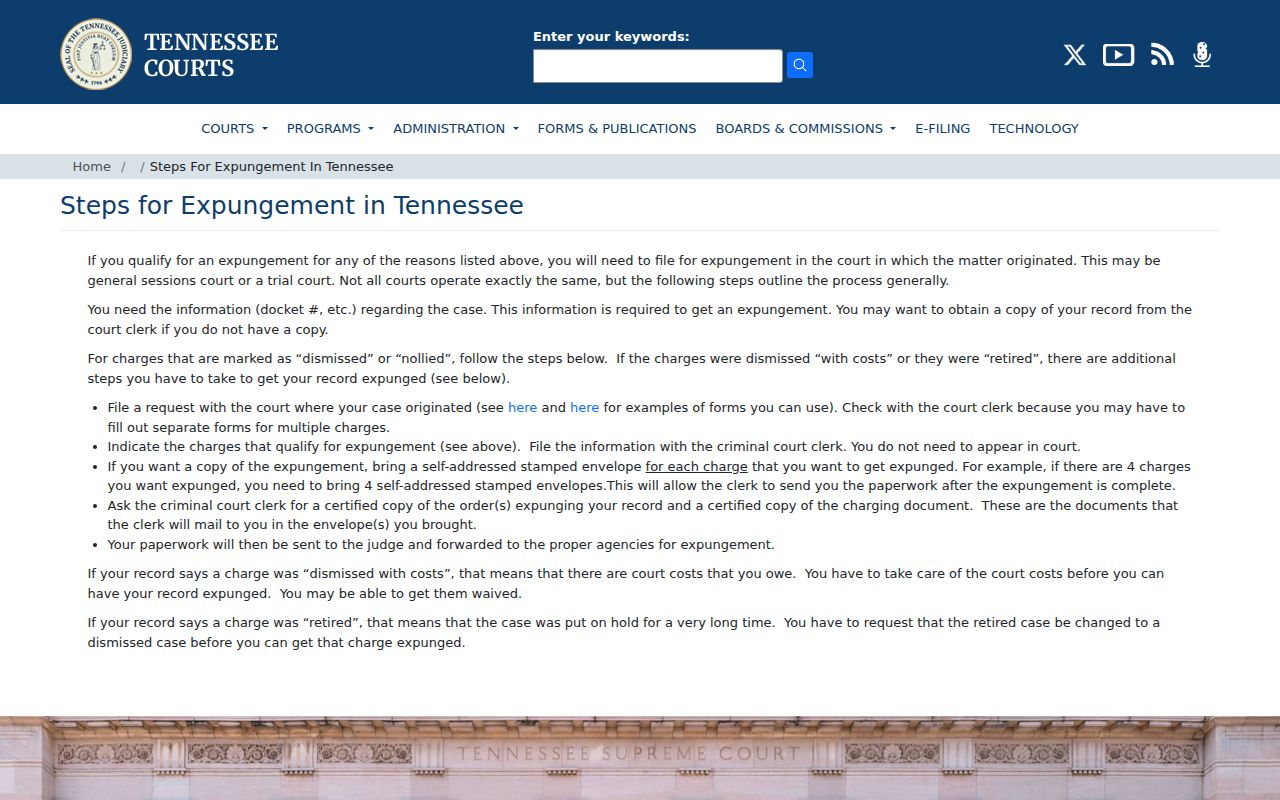
The court route begins with the actual Claiborne County charge and its disposition, not a loose name match. Tennessee Courts also publishes no-fee outcome guidance and a TBI expungement routing summary for checking which official receives an order.
Read Claiborne County Case Outcomes
Claiborne County court terms can change the meaning of a result. Read the judgment and the latest docket entry together. An old entry marked pending may have been followed by a later disposition.
- Nolle prosequi
- The prosecution elects not to proceed with the charge.
- Dismissed
- The court ends the charge; it is not a conviction.
- Acquitted
- A not-guilty verdict after trial.
- Convicted
- Guilt established by a plea or verdict and supported by judgment.
- Capias
- A court command directing that a person be taken into custody.
Note: A probation-violation filing is later activity in the supervision case and is not automatically a new criminal conviction.
Stages of a Criminal Case
A Claiborne County criminal case may start with an arrest or citation and a probable-cause review. Claiborne County General Sessions handles early felony proceedings before a grand-jury indictment. Criminal Court then handles arraignment, discovery, motions, plea or trial, judgment, sentence, and later litigation. Not every case reaches every stage, and the filed count may change along the way.
Case flow: Charges Filed › Arraignment › Pretrial › Plea or Trial › Disposition › Sentencing
Appeals and post-conviction filings are separate later steps. The Claiborne clerk expressly lists both among its holdings. Trial exhibits may need staff review and may not be digitized, so ask what is available before ordering a full file.
Older Claiborne County Court Files
Older circuit material may be stored off site or routed to the county archives. Begin with the current clerk because staff can identify the court, date range, and likely custodian. Then use the archives when the record has moved out of the active file set.
The Claiborne County Archives page confirms that historic circuit-court material is part of its holdings.
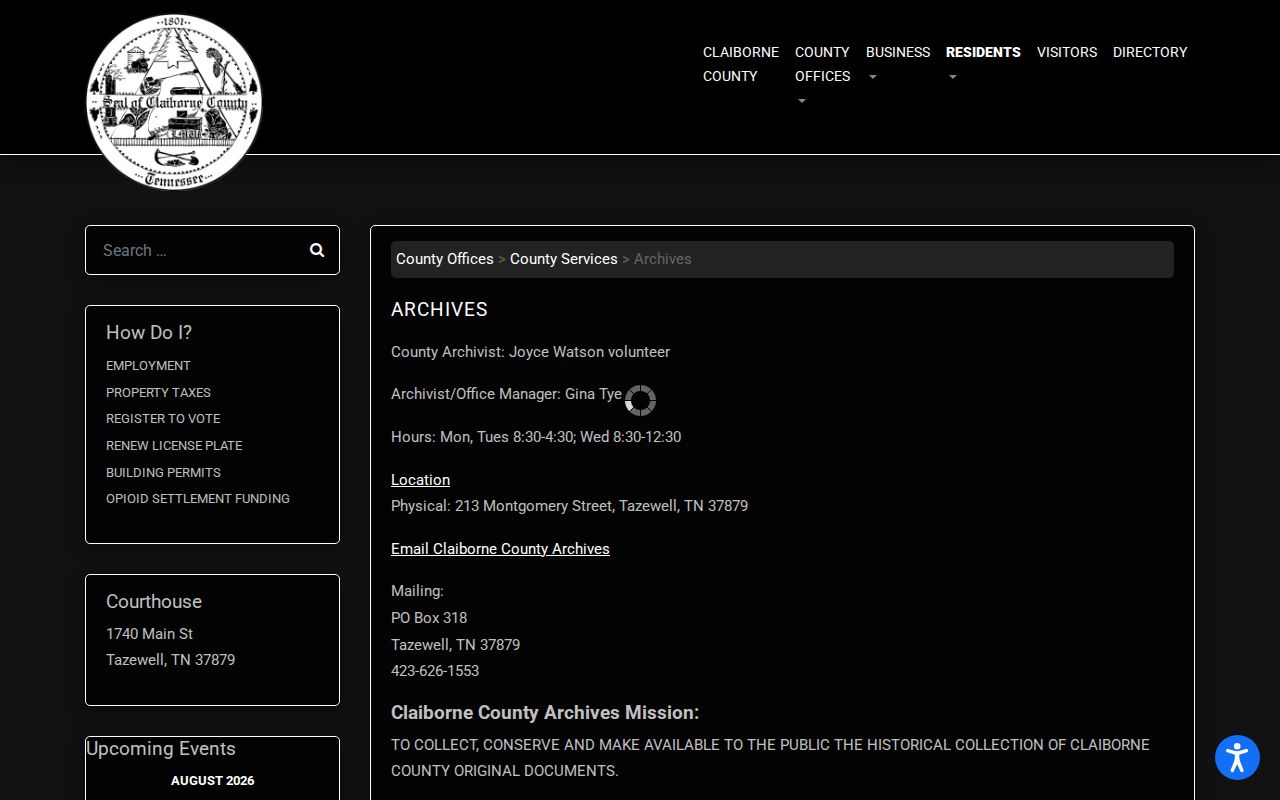
This county-run archive is a sound route for genealogy and long-range case research when the active criminal counter no longer holds the file.
Access & Restrictions
Tennessee Supreme Court Rule 34 supports public inspection of court records unless a statute, another rule, or a court order makes the material confidential. The Tennessee Public Records Act also governs access. Public status does not mean each field or exhibit must be released without review.
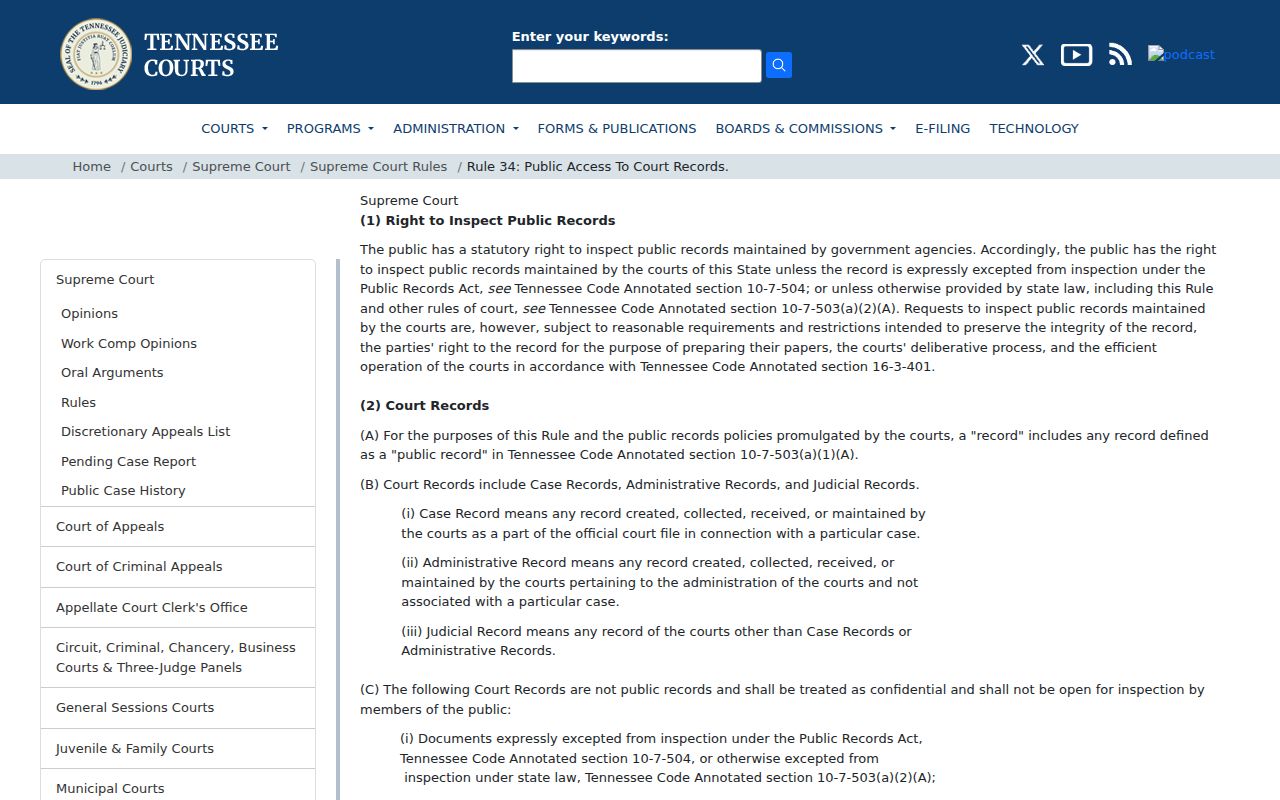
The Rule 34 source helps explain why the clerk may provide a redacted copy or withhold a protected part of a Claiborne County file.
Juvenile records, victim-sensitive data, protected identifiers, sealed or expunged matters, active investigative material, and some search-warrant information can be restricted in Claiborne County. Narrow requests reduce review time. Ask whether inspection, a plain copy, or a certified copy best fits the intended use.
Federal Cases Beyond Claiborne County
A federal prosecution is not stored as a Claiborne County state-court case. Claiborne County lies within the U.S. District Court for the Eastern District of Tennessee. PACER is the official federal docket service and requires an account; usage fees may apply.
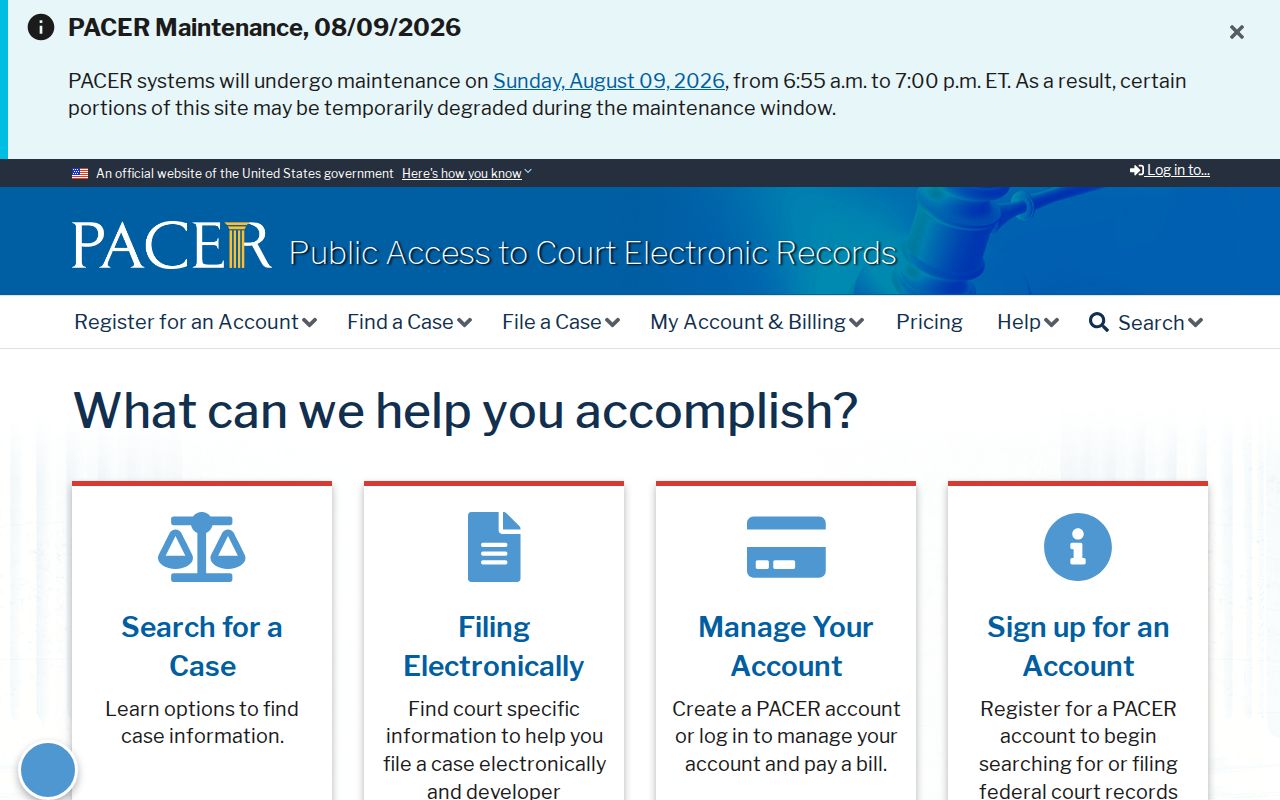
PACER supplies the docket and filed federal papers, while the county clerk remains the source for Claiborne County state charges.
The Eastern District of Tennessee identifies the federal court serving the area.
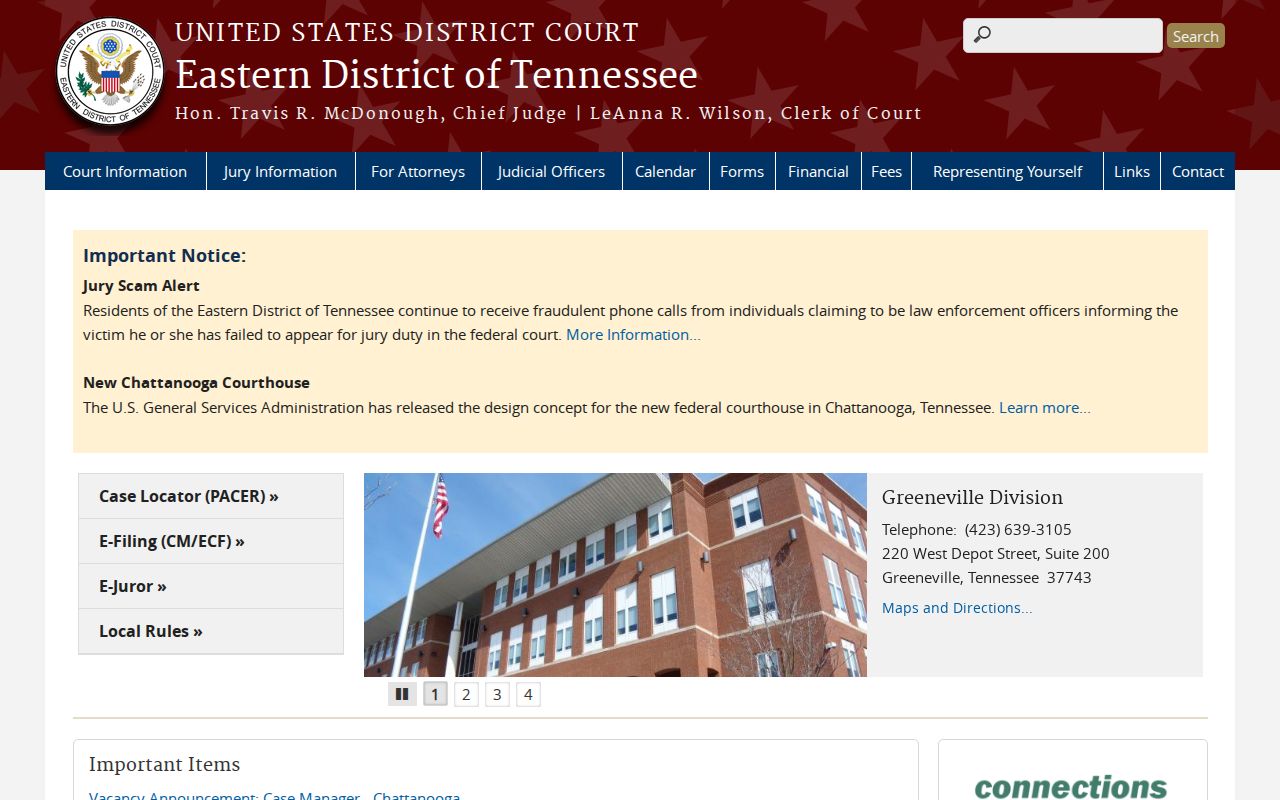
The district court image marks a distinct record system, so a Claiborne County-only search cannot establish whether a federal case exists.